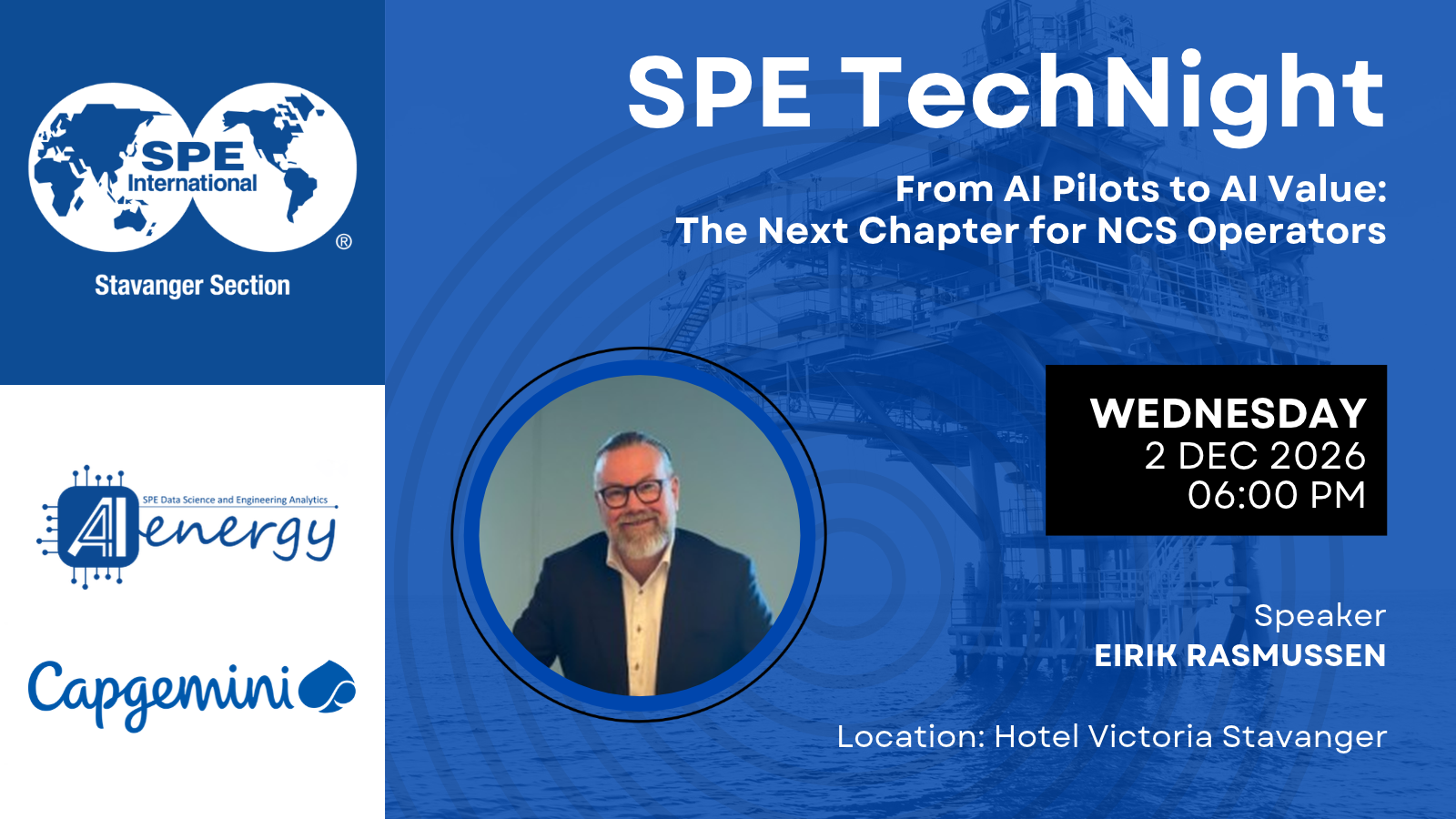
Presented by:
Eirik Rasmussen
Director of Business Development, Capgemini
In collaboration with SPE AI4Energy (SPE Data Science and Engineering Analytics Technical Section)
Date: 2nd December 2026
Time: 1800 (Presentations start 1830)
Place: Victoria Hotel
Menu: • Soup (chef's choice) • Christmas platter: lamb & pork ribs with traditional side dishes • Rice pudding with whipped cream
The presentation is free of charge and open to everyone. Registration is only required for the following dinner. Cancellations must be made before the registration deadline and are subject to a small fee.
Abstract
Every NCS Operator Has an AI Pilot. Few Have Generated Value.
Why the Future of AI in E&P Depends Less on Models and More on Data, Operating Models and Organisational Learning
Every NCS operator has multiple AI pilots. Yet few have translated experimentation into sustainable business value.
Over the past two years, the NCS has invested heavily in platforms, copilots, agents and generative AI. While (globally) the technology continues to evolve at remarkable speed, many NCS operators remain stuck in proof-of-concept mode, struggling to turn technical success into measurable operational outcomes.
For Capgemini the reason is increasingly clear: the challenge is no longer the technology.
For decades, competitive advantage in E&P has come from turning data into better decisions. Whether in reservoir management, production optimisation, drilling or operations, the strongest performers are often the organisations that (use AI to) learn faster, collaborate better, and systematically apply experience across assets, disciplines and generations of engineers.
AI has the potential to accelerate this dramatically. But only when it is built on trusted data, embedded into real new workflows, and connected to feedback loops that allow both people and technology to continuously learn and improve.
AI capabilities are becoming accessible to everyone. The real differentiator lies in what surrounds them: trusted data, AI-ready ways of working, product-centric delivery models, and operating models that capture, scale and continuously improve organisational knowledge.
In this session, Eirik Rasmussen shares an unfiltered perspective on the current state of GenAI in E&P, where the technology is heading, and what separates organisations that scale value from those that merely scale pilots.
Drawing on experiences from leading E&P operators, the session explores how organisations are moving beyond isolated AI initiatives and towards operating models that continuously learn, adapt and improve. Through practical examples from operational and production-focused environments, participants will see how trusted data, engineering expertise and AI can be combined to create compounding business value over time.
Eirik's session will cover:
- The current state of GenAI and what comes next in the E&P industry
- Why many AI initiatives struggle to move beyond proof of concept
- The role of trusted data foundations and AI-ready operating models
- How continuous feedback loops improve AI outcomes over time
- Lessons learned from deploying AI in operational environments
- Why the future is not AI replacing engineers, but organisations learning systematically (supported by AI) from their best engineers
The winners will not be the organisations with the smartest AI - it will be the organisations that learn, adapt and scale faster than everyone else.
Come for AI predictions. Stay and work with us for the uncomfortable scale questions.
Biography
Eirik Rasmussen is a Director of Business Development at Capgemini with more than 30 years of international management and consulting experience across the energy and IT industries. He holds an Executive MBA from the Norwegian School of Economics (NHH) and the National University of Singapore, with a specialization in strategic management.
Based in Stavanger, Eirik specializes in strategy, digitalisation and organisational transformation in the energy sector. Drawing on extensive experience in corporate governance, operational improvement, information management and sustainable production, he has served as an industry expert for Norwegian and international energy companies, leading major strategy and change programmes at the intersection of business, processes and technology.
His current focus includes helping energy companies turn emerging technologies, including AI and agentic AI, into scalable operational solutions that support business growth, transformation and measurable value creation.
Following the presentation, a networking dinner will offer the perfect chance to discuss ideas, collaborate, and expand your professional network.